CART
A corrective action program is the part of a nuclear quality assurance system that decides whether problems get smaller or repeat. NQA-1 and 10 CFR 50 Appendix B both require it, and both draw the same line that ordinary quality systems do not: conditions adverse to quality are corrected, while significant conditions adverse to quality also require the cause to be determined and corrective action taken to preclude recurrence.
This guide covers that distinction, what each path obliges you to do, and the three failures that turn a corrective action program into a backlog.
Free gap assessment
Are you ready for the 2026 edition of ISO 9001?
Score yourself against the new edition, free, including the risk and opportunity split and the clause 10 renumbering that breaks converted checklists.
Run the free ISO 9001 gap assessment → or View premium report sample
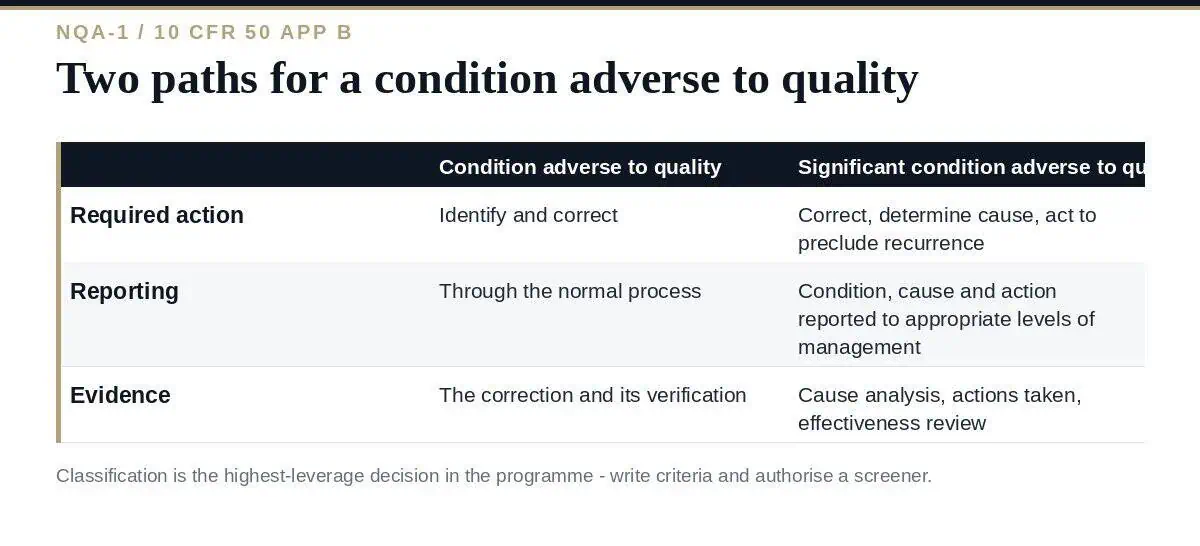
A condition adverse to quality is any deficiency — a failure, malfunction, defective item, deviation, or nonconformance. The requirement is that it is identified and corrected.
A significant condition adverse to quality carries more. The cause has to be determined, corrective action taken to preclude recurrence, and the condition, its cause and the corrective action reported to appropriate levels of management. The word doing the work is preclude: fixing the item is not enough if the mechanism that produced it remains in place.
| Condition adverse to quality | Significant condition adverse to quality | |
|---|---|---|
| Required action | Identify and correct | Correct, determine cause, act to preclude recurrence |
| Reporting | Through the normal process | Condition, cause and corrective action to appropriate levels of management |
| Evidence | The correction and its verification | Cause analysis, actions, effectiveness review |
Which means the classification step is the highest-leverage decision in the program — and the one most often made by whoever raises the condition, with no criteria in front of them.
A corrective action program needs written criteria applied at screening, by a person with the authority and knowledge to judge. Useful triggers for the significant path:
Screening should be a daily rhythm, not a monthly meeting. Conditions age badly: evidence disappears, the people involved forget, and a condition that could have been understood in a week takes a month.
Three habits separate real cause analysis from the appearance of it:
An action taken is not an action that worked. Set a review point when the action is defined — a date, a sample, or a trigger — and record the finding, including when the answer is that the condition recurred. A corrective action program whose entries all close as effective is not measuring effectiveness.
Classification inflation, then paralysis. Everything is marked significant, the root cause queue grows past capacity, and genuinely significant conditions wait behind trivia. The fix is criteria plus an authorized screener, not more analysts.
Low-threshold reporting without low-threshold handling. A strong safety culture encourages reporting minor conditions — which is right — but the program has to have a proportionate path for them, or people learn that raising something creates work and stop.
Trending that nobody uses. The program generates the best data in the organization: what fails, where, how often. If the trend analysis does not change training, procedures or supplier decisions, the data is being collected for its own sake.
The corrective action program is the connective tissue of an NQA-1 quality assurance program. Audits and surveillances feed it, the graded approach determines how much rigour each condition attracts — see the graded approach — and the regulatory baseline sits in 10 CFR 50 Appendix B, whose criteria the program has to satisfy alongside NQA-1 itself.
What is a condition adverse to quality?
A deficiency such as a failure, malfunction, deviation, defective item or nonconformance. It must be identified and corrected.
What makes a condition significant?
Your classification criteria, applied consistently — typically safety impact, recurrence, programmatic breakdown or escape to the customer. Significant conditions additionally require cause determination, action to preclude recurrence, and reporting to management.
Is a corrective action program required by 10 CFR 50 Appendix B?
Yes. The corrective action criterion carries the same two-tier structure, which is why NQA-1 programmes and Appendix B programmes use the same vocabulary.
Who should perform root cause analysis?
Somebody independent of the work being analysed, trained in the method. Self-analysis by the responsible group produces causes that stop conveniently short.
How long should conditions stay open?
Long enough to do the analysis properly and no longer. Track age and overdue counts, and treat a growing backlog as a condition in its own right.
Build the corrective action program around the classification decision: written criteria, an authorized screener, and daily screening. Reserve formal root cause for genuinely significant conditions, always ask where else the cause could have acted, and set the effectiveness review when the action is defined rather than after it closes. Then use the trend data to change something — a program that records conditions faithfully and changes nothing is an archive, not a corrective action program.
Condition reports, cause analysis forms and effectiveness review records are in the Nuclear Quality Assurance Toolkit, or start with the free ISO templates.

October 22, 2026
October 22, 2026
October 22, 2026
October 22, 2026
October 22, 2026

