CART
Special characteristics are the small number of product and process features where variation actually matters — to safety, to regulatory compliance, to fit or to function — and IATF 16949 treats them as a thread running through the whole quality system rather than a label on a drawing.
This guide covers what makes a characteristic special, the documents the designation has to reach, and the failure that produces findings in almost every automotive audit: a characteristic identified in the FMEA that never arrives at the control plan.
Free gap assessment
Where do you stand on the automotive supplemental requirements?
Score only what IATF adds to ISO 9001, free, including customer-specific requirements, product safety and the core tools.
Run the free IATF 16949 gap assessment → or View premium report sample
A special characteristic is a product characteristic or manufacturing process parameter whose variation can significantly affect safety, compliance with regulations, fit, function, performance or the subsequent processing of the product. Two sources create them:
Customer symbols are not interchangeable and their obligations differ. One manufacturer’s safety symbol may require capability studies at a defined index and 100% verification; another’s may require error-proofing. Our guide to customer-specific requirements covers where those rules live and why they cannot be generalized.
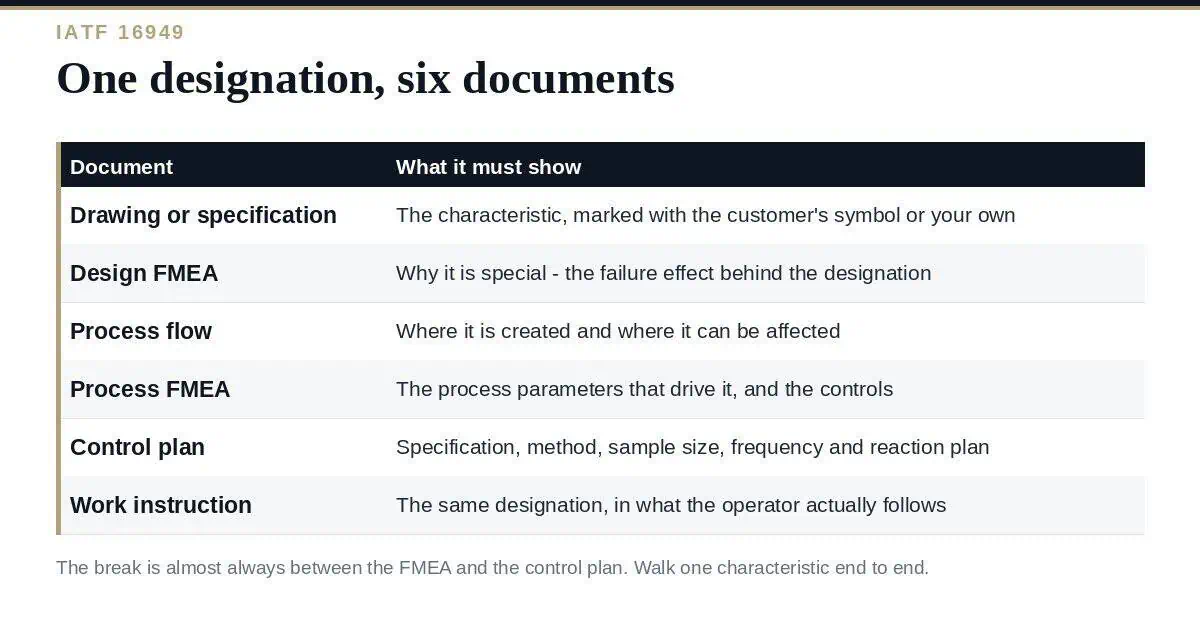
| Document | What it must show |
|---|---|
| Drawing / specification | The characteristic, marked with the customer’s symbol or your own where the customer has none |
| Design FMEA | Why it is special — the failure effect that justifies the designation |
| Process flow | The operations where it is created and where it can be affected |
| Process FMEA | The process parameters that drive it, and the controls preventing or detecting variation |
| Control plan | The characteristic, the specification, the measurement method, sample size and frequency, and the reaction plan |
| Work instruction | The instruction the operator actually follows, carrying the same designation |
Add the records that follow from it: capability studies where the customer requires them, the measurement system analysis proving the gauge can see the variation, and the reaction records when a characteristic goes out of control.
Take one of your special characteristics and walk it end to end. Drawing to design FMEA to process flow to process FMEA to control plan to work instruction to the last capability study to the reaction plan and the record of the last time it triggered. Auditors do exactly this, and the break is almost always in the same place: the FMEA identifies it, the control plan omits it or lists a different specification, and the operator’s instruction never mentions it at all.
The cause is usually revision drift — the drawing was updated, the FMEA followed six weeks later, and the control plan and instruction were never re-issued. Any change to a special characteristic should trigger a defined set of document updates, and the change record should show all of them moving together.
Marking special characteristics is not the requirement; controlling it is. In practice a special characteristic pulls in:
That last point is the one most often missed in a multi-tier supply chain. A special characteristic delegated without the designation is an ordinary dimension to the supplier producing it.
Who identifies special characteristics?
Both the customer and the organization. Customer-designated ones arrive through drawings and customer-specific requirements; organization-designated ones come out of the design and process FMEAs.
Do we have to use the customer’s symbols?
Where the customer specifies symbols, yes — and their meaning and obligations are defined in their requirements, not by convention. Where there are none, use your own consistently and define them.
What is the difference between a safety and a significant characteristic?
Terminology varies by customer. Broadly, safety and regulatory characteristics carry the strictest controls, while others affecting fit, function or subsequent processing carry lighter ones. Follow the customer’s definitions rather than a generic scheme.
Does every special characteristic need a capability study?
Where the customer requires it, and where the characteristic is measurable and produced by a stable process. Attribute characteristics are usually controlled by error-proofing and verification instead.
What happens at PPAP?
The submission has to demonstrate the characteristics are identified, controlled and capable. Inconsistency between the FMEA, control plan and study is a common reason for rejection — see our guide to the IATF 16949 core tools.
Treat special characteristics as one designation flowing through six documents rather than a symbol on a drawing. Keep the list short enough to mean something, make any change to one trigger updates to every document that carries it, prove the gauge before you argue about capability, and write reaction plans an operator can execute at 3 a.m. Then walk one characteristic end to end yourself, before an auditor does — the break is nearly always between the FMEA and the control plan.
FMEA, control plan and characteristic-flow templates are in the IATF 16949 Toolkit, or start with the free ISO templates.

October 24, 2026
October 24, 2026
October 23, 2026
October 23, 2026
October 22, 2026

