CART

A shared responsibility matrix is the document that decides who patches the operating system, who configures the encryption and who notices the failed backup. ISO 27017 exists largely because those questions have two possible answers in cloud computing, and the standard’s most-cited control asks the provider and the customer to agree and document the split.
This guide covers what belongs in the matrix, how to build one that survives an audit, and the failure that turns a signed contract into an unprotected system.
Free gap assessment
Where do you actually stand against ISO 27001?
Score every management system clause and all 93 Annex A controls, free, and get a prioritised gap list back.
Run the free ISO 27001 gap assessment → or View premium report sample
In an on-premises system one organization owns every layer. In cloud computing the layers are split between a provider and a customer, and the split moves with the service model. Nobody disputes this in principle; the trouble is that both parties often assume the other holds a given control, and neither holds it.
ISO 27017 addresses that directly. The extension exists because responsibility in cloud computing is divided, and divided responsibility is where things get dropped — its cloud-specific controls include one asking that shared roles and responsibilities be allocated and documented, and another extending that allocation to the wider chain of cloud partners rather than just the two names on the contract.
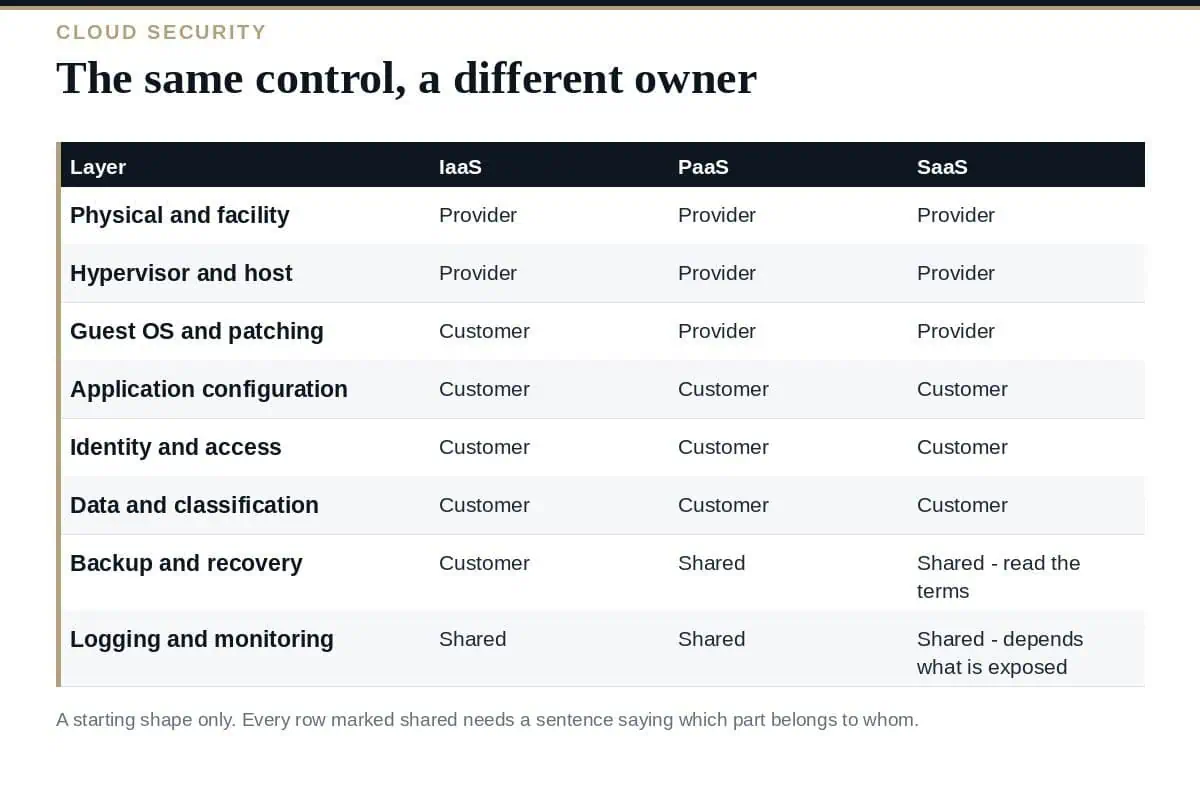
| Layer | IaaS | PaaS | SaaS |
|---|---|---|---|
| Physical and facility | Provider | Provider | Provider |
| Hypervisor and host | Provider | Provider | Provider |
| Guest OS and patching | Customer | Provider | Provider |
| Application configuration | Customer | Customer | Customer |
| Identity and access | Customer | Customer | Customer |
| Data and classification | Customer | Customer | Customer |
| Backup and recovery | Customer | Shared | Shared — read the terms |
| Logging and monitoring | Shared | Shared | Shared — depends on what is exposed |
Treat that shared responsibility matrix as a starting shape, not an answer. The genuinely load-bearing rows are the ones marked shared, because “shared” is where both parties do part of the work and each assumes the other does the rest. Every shared row needs a sentence saying exactly which part belongs to whom.
Backup in SaaS. The provider backs up its platform to recover from its own failures. That is not the same as being able to restore your data after a user deletes it or a synchronization error propagates, and the retention period in the terms is usually shorter than anyone assumes.
Logging. The provider may generate the logs and still not retain them for as long as you need, or expose them in a form your monitoring can consume. Availability, retention and export are three separate questions.
Identity. Almost always the customer’s, almost always under-resourced. Provider-side identity features exist, but configuring them, reviewing access and removing leavers is customer work in every service model.
The test of a good shared responsibility matrix is simple: hand it to somebody on call and ask who fixes a named failure. If they have to interpret it, it is not finished.
The matrix is the artefact several regimes ask for in different words. ISO 27017 asks for the roles and responsibilities to be agreed and documented per service. CSA STAR’s questionnaire asks which actor implements each control, so a completed matrix substantially populates a CAIQ — see our guide to the Cloud Controls Matrix. Assurance reports carry the same idea as complementary user entity controls: the things the report’s readers must do for the provider’s controls to work.
Note the edition position on the standard itself: ISO/IEC 27017:2026 replaced the 2015 edition in July 2026, and the old CLD control identifiers no longer exist — the cloud controls now sit inside the ISO 27002:2022 numbering. Documentation citing CLD numbers is describing a withdrawn edition. Our guide to ISO 27017 and what the 2026 edition changes has the mapping.
Does the provider supply the shared responsibility matrix?
Most publish a model, and it is a useful starting point. It is not your matrix: it describes their general position, not your service, your configuration or your data.
Is it a contractual document?
It should be traceable to contractual commitments, but the matrix itself is usually an operational artefact. Where a row matters commercially, get the commitment into the agreement rather than the diagram.
What about multi-cloud?
One matrix per service, and a register listing them. Averaging across providers hides exactly the differences that cause incidents.
Who owns it internally?
Whoever owns the service relationship, reviewed by security. A matrix owned only by security tends to describe intentions rather than operations.
How often should it be reviewed?
On change, and at least annually alongside the supplier review. Provider defaults move quietly.
Build a shared responsibility matrix per cloud service, anchored to your control set, with a named evidence source behind every provider row and a sentence of detail behind every shared one. Extend it to subcontractors, review it when the service changes, and test it by asking somebody on call who fixes what. The controls nobody owns are the ones that fail, and this is the only document whose job is to find them before an incident does.
Responsibility matrices, cloud control mappings and supplier review records are in the ISO 27017 & ISO 27018 Cloud Toolkit, or start with the free ISO templates.

October 24, 2026
October 23, 2026
October 23, 2026
October 22, 2026
October 22, 2026

