CART
Risk criteria are where a risk management framework either becomes usable or quietly stops working. They are the terms of reference against which the significance of a risk is evaluated — the scales, the thresholds, and the point at which something stops being tolerable. ISO 31000 puts them in clause 6.3, alongside scope and context, and before any risk is assessed.
That placement is the whole argument. Criteria set before assessment produce comparable results; criteria invented afterwards produce a heat map that reflects whoever scored last.
Free gap assessment
Is risk management actually changing decisions?
A maturity assessment against all eight principles, the framework and the process, free. Nobody can certify you to ISO 31000, so this scores distance from good practice instead.
Run the free ISO 31000 maturity assessment → or View premium report sample
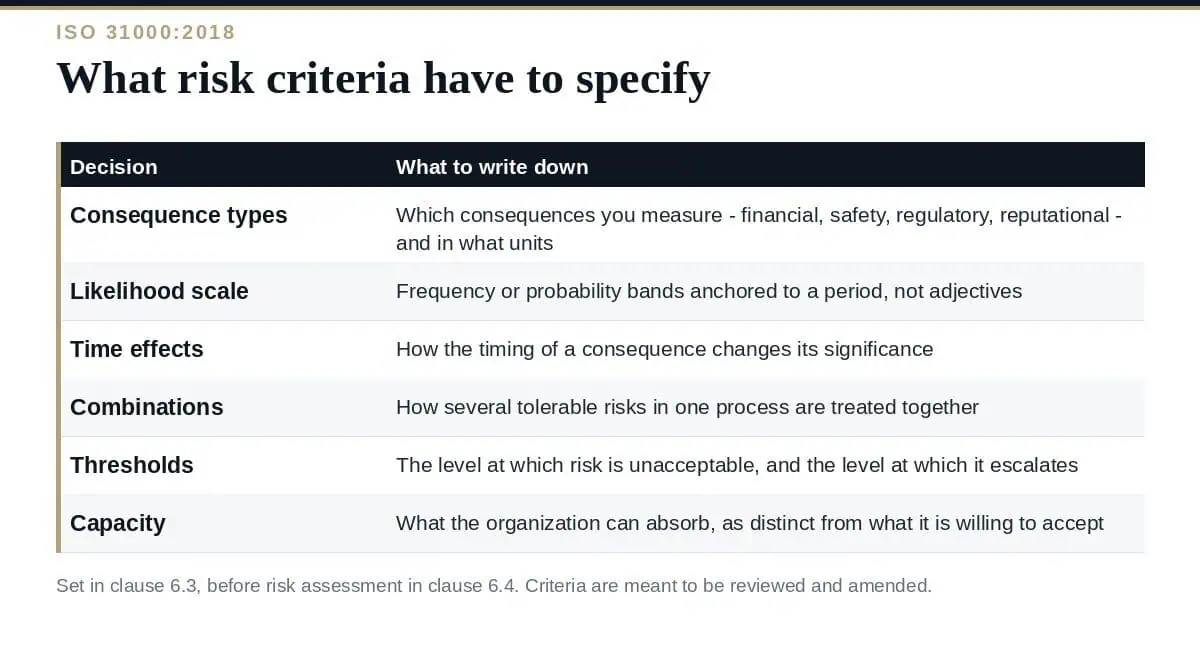
ISO 31000 expects the organization to specify the amount and type of risk it may or may not take, relative to its objectives, and to define criteria for evaluating the significance of risk. In practice that means writing down six things:
Criteria should be dynamic. ISO 31000’s own position is that they are reviewed and amended as circumstances change, which means a criteria set that has not been touched since the framework was written is evidence the framework is not being used.
These three get used interchangeably and they are not the same:
An appetite statement without criteria cannot be applied by anyone below the board. Criteria without an appetite statement produce consistent scoring in the service of no stated intent. You need both, and the criteria are the half that gets skipped.
The failure mode is a five-by-five grid with undefined labels. “Moderate impact” means whatever the scorer thinks it means, so two people score the same risk differently and the register stops being comparable across departments.
Three fixes, in order of value:
Anchor every point on the scale to something measurable. Not “major financial impact” but “loss above X% of annual revenue, or above Y in absolute terms”. Not “likely” but “expected more than once in three years”. If a number is politically difficult to agree, that difficulty is the real finding — it means the organization has never stated what it can absorb.
Use several consequence types with one shared severity scale. A safety consequence and a financial consequence are not comparable in their own units, but both can be mapped onto the same five levels, and that is what lets a portfolio be ranked.
Write the criteria where the scorers will see them. On the register sheet, not in a framework document nobody opens. The single cheapest improvement to most risk registers is putting the definitions next to the scoring columns.
Free enterprise risk assessment
Which of your business risks sit above your appetite?
Set your criteria and appetite, pick from 36 strategic, financial, operational and compliance scenarios, rate them and decide how to treat each. Built to ISO 31000, and free.
Run the free enterprise risk assessment → or View premium report sample
Four failure patterns account for most unusable risk criteria.
The mid-table cluster. When most entries land in the middle of the grid, nobody is making a judgement — usually because the scale’s endpoints are so extreme that nothing real reaches them. Calibrate against risks you have actually experienced.
Criteria that ignore capacity. Appetite says what you want; capacity says what you can survive. A criteria set that permits accepting a risk the balance sheet cannot absorb is not a criteria set, it is optimism.
One scale for the whole organization, no matter the scale of the unit. A threshold calibrated for group level makes every risk in a small subsidiary look trivial. Either set unit-level criteria that roll up, or state the level the criteria apply at.
Never revisiting them. Growth, acquisition, a new regulator or a bad year all change what is tolerable. Criteria are meant to be amended; the register’s history should show it happening.
ISO 31000 is guidance and is not certifiable, but the standards that are certifiable lean on the same idea. ISO 27001 requires information security risk criteria — including risk acceptance criteria — to be established and maintained before assessment, and management-system standards generally expect the basis for evaluating significance to be defined rather than improvised. Setting criteria once, properly, satisfies several regimes at once. Our guide to ISO 31000 and its three components covers the framework the criteria sit inside.
Where are risk criteria defined in ISO 31000?
In clause 6.3, scope, context and criteria — before risk assessment in clause 6.4, which is the point.
Are risk criteria the same as risk appetite?
No. Appetite is the amount and type of risk the organization is willing to pursue or retain; criteria are the scales and thresholds that let a specific risk be evaluated against it.
Who sets them?
The board or top management sets appetite and approves the criteria; risk and business owners apply them. Criteria written entirely by a risk function tend not to survive contact with a business decision.
How often should they be reviewed?
Whenever the organization’s objectives, capacity or environment change, and at least as part of the periodic framework review. ISO 31000 expects them to be dynamic.
Can we use qualitative criteria?
Yes, provided each level is defined well enough that two people apply it the same way. Qualitative does not mean undefined.
Write the risk criteria before the first assessment, anchor every level to something measurable, and keep the definitions in front of whoever is scoring. State appetite and criteria separately so the board’s intent and the operational thresholds are both visible, include capacity as well as willingness, and review the criteria when the business changes. A register scored against undefined labels cannot be aggregated, compared or defended — and that is a criteria problem, not a scoring one.
Criteria sets, scoring scales and the register they feed are in the ISO 31000 Risk Management Toolkit, or start with the free ISO templates.

October 24, 2026
October 24, 2026
October 23, 2026
October 23, 2026
October 22, 2026

