CART
A cybersecurity risk register is the artifact that lets a security team say something a board can act on: here is the risk, here is what it would cost us, here is who owns it, and here is what we are doing about it. NIST’s guidance on building one was revised in December 2025 — IR 8286 Revision 1 replaced the 2020 original — and the register template at its centre is the most reusable part of the whole publication.
This guide sets out the ten elements NIST puts in the template, what each is for, and how registers roll up from systems to the enterprise without turning into a spreadsheet nobody reads.
Free gap assessment
Where do you actually stand against ISO 27001?
Score every management system clause and all 93 Annex A controls, free, and get a prioritised gap list back.
Run the free ISO 27001 gap assessment → or View premium report sample
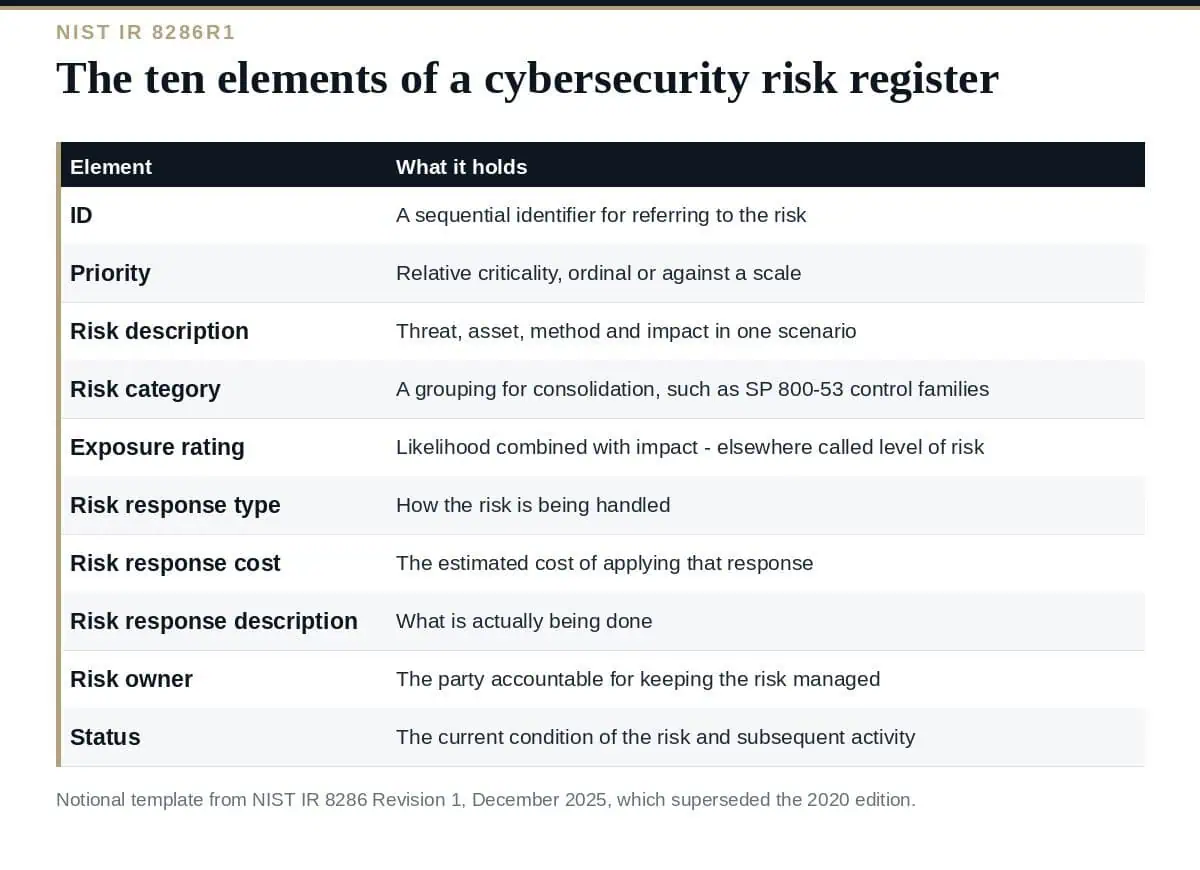
| Element | What it holds |
|---|---|
| ID | A sequential identifier for referring to the risk |
| Priority | Relative criticality, as an ordinal value or against a scale |
| Risk description | The scenario, phrased consistently — threat, asset, method and impact all present |
| Risk category | A grouping that lets entries be consolidated by theme, such as SP 800-53 control families |
| Current assessment — exposure rating | Likelihood combined with impact; other frameworks call this the level of risk |
| Risk response type | How the risk is being handled — the treatment |
| Risk response cost | The estimated cost of applying that response |
| Risk response description | What is actually being done, specifically enough to act on |
| Risk owner | The party accountable for keeping the risk managed to enterprise requirements |
| Status | The current condition of the risk and any subsequent activity |
NIST is explicit that this is notional — the composition will vary and may hold more or fewer data points. What matters is that whichever model you pick is used consistently and iteratively. The template also lines up with what OMB Circular A-11 says a risk register typically contains: a description, the impact, the probability, mitigation strategies, risk owners and a ranking.
Free ISO 27001 risk assessment
Which of your risks sit above your appetite line?
Set your own risk criteria, pick from 61 information security risk scenarios, rate likelihood and impact, and decide how to treat each one. You get a heat map, a process score and the findings an auditor would raise, free.
Run the free risk assessment → or View premium report sample
Risk response cost is the field most registers omit, and it is the one that turns a security list into a business conversation. A risk with an unquantified response is a request for goodwill; a risk with a cost is a decision the enterprise can take, defer or accept knowingly.
Risk owner is the field most often filled in wrongly. NIST’s definition is the party responsible and accountable for ensuring the risk is maintained in accordance with enterprise requirements — and it notes the owner may work with a risk manager who monitors the chosen response. Those are two roles. Putting the security team in both means the enterprise has not actually accepted anything.
Risk documentation often references inherent risk — the condition that would exist with no organizational intervention. NIST points out that in any real scenario the enterprise has already taken at least small steps, so its guidance refers to current risk: risk that has been at least partially addressed by management action.
That is a more useful default than it sounds. A cybersecurity risk register built on inherent risk produces a wall of extreme ratings that never move and that nobody believes, because they describe a company that does not exist. Some organizations record both the current assessment and the expected position after the response is applied, which gives the board the delta the investment is buying.
The structure IR 8286 describes runs system → organization → enterprise. Individual cybersecurity risk registers are prioritized at the organization level, then correlated, aggregated and normalized into an enterprise risk profile that sits alongside the other risk types the enterprise faces.
Three things make that roll-up work, and their absence is why most cybersecurity risk register programmes stall at the organization level:
NIST publishes a risk register schema in JSON and Excel alongside the document, which is worth taking if you are building tooling — a shared schema beats a shared template when several teams are contributing.
What is the current NIST guidance on risk registers?
NIST IR 8286 Revision 1, Integrating Cybersecurity and Enterprise Risk Management (ERM), published December 2025. It supersedes the October 2020 original and retains the cybersecurity risk register at its centre.
What is the difference between a risk register and a risk profile?
A register is a list of risks with their assessments, responses and owners. An enterprise risk profile is the aggregated, normalized view compiled from those registers for enterprise decision-making.
Should we record inherent or current risk?
Current risk, as NIST’s guidance does — the position after the interventions already in place. Recording the expected post-response position as well gives the clearest picture.
How does this relate to ISO 31000?
The vocabulary differs but the mechanics do not: what NIST calls exposure, ISO 31000 and SP 800-30 call level of risk. A single register can serve both if the scale is defined once.
Who owns the register?
The risk owner owns each entry; a risk manager typically maintains the register and monitors responses. Keeping those roles distinct is what stops the register becoming a security-team artifact.
Build the cybersecurity risk register with all ten elements, and be strict about the three that people skip: response cost, a real owner outside the security team, and a status that changes. Score current risk rather than inherent, phrase every scenario with threat, asset, method and impact so entries can be compared, and categorize consistently enough that registers can be aggregated. Then report the movement — the register earns its keep when it shows what changed, not when it lists what exists.
Register templates, scoring scales and reporting formats are in the NIST Cyber Risk Management Toolkit, or start with the free ISO templates.

October 23, 2026
October 22, 2026
October 22, 2026
October 22, 2026
October 22, 2026

