CART
A crypto-asset white paper under MiCA is a regulated disclosure document, not a marketing artifact. Article 6 of Regulation (EU) 2023/1114 sets what it must contain, Annex I sets the disclosure items in nine parts, and Article 15 makes the offeror and the members of its management body liable to holders for information that is incomplete, unfair, unclear or misleading.
This guide covers when a crypto-asset white paper is required, what has to be in it, the mandatory statements, how notification and publication work, and the traps that catch teams treating it as a document-formatting exercise.
For crypto-assets other than asset-referenced tokens and e-money tokens, the obligation attaches to offering to the public or seeking admission to trading. MiCA then carves out several situations. The Title does not apply to an offer:
Read those exemptions narrowly and document the reasoning at the time. “Offered for free” does not cover a token given in exchange for personal data or for services, and the 150-person and EUR 1,000,000 thresholds are per Member State and per 12 months respectively — a structure that is easy to breach by accident across a rolling campaign.
Asset-referenced tokens and e-money tokens have their own white paper regimes with their own disclosure annexes, and issuing an ART additionally requires authorization. If your token references a basket of assets or a single official currency, you are not in the regime described below.
The content requirement is set in two layers: Article 6 states the categories, and Annex I turns each into itemized disclosures.
Article 6(1) requires the white paper to contain information about the offeror or person seeking admission to trading; about the issuer if different; about the operator of the trading platform where it draws up the white paper; about the crypto-asset project; about the offer or the admission to trading; about the crypto-asset itself; about the rights and obligations attached to it; about the underlying technology; about the risks; and about the principal adverse impacts on the climate and other environment-related impacts of the consensus mechanism.
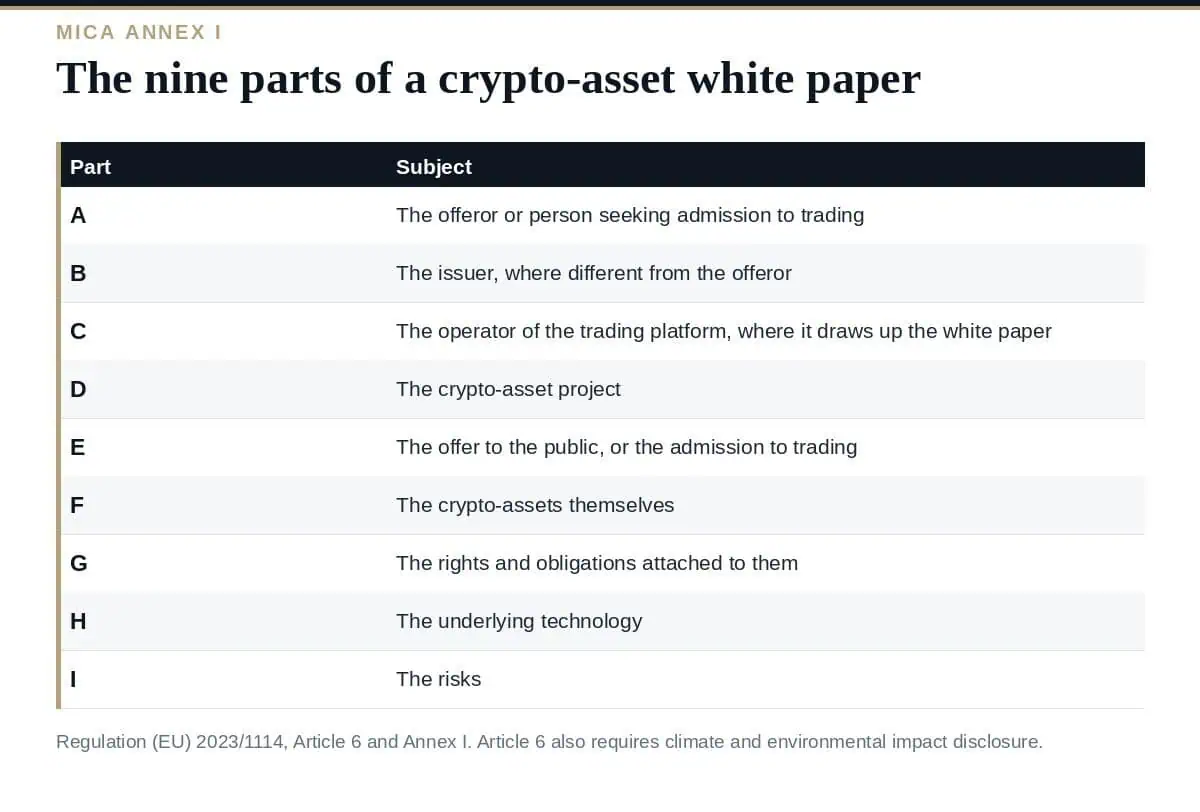
Annex I turns those headings into disclosure items across nine parts:
| Part | Subject |
|---|---|
| A | The offeror or person seeking admission to trading |
| B | The issuer, where different from the offeror |
| C | The operator of the trading platform, where it draws up the white paper |
| D | The crypto-asset project |
| E | The offer to the public, or the admission to trading |
| F | The crypto-assets themselves |
| G | The rights and obligations attached to them |
| H | The underlying technology |
| I | The risks |
Part A alone runs to identity and contact details, legal form, registered address, date of registration, a legal entity identifier, the parent company where applicable, and the identity and functions of the people managing the offeror — including a response time commitment for the contact channel you publish.
Three mandatory elements catch teams that draft from a template found online:
A statement from the management body follows, confirming compliance with the Title and that, to the best of its knowledge, the information is complete, fair and clear and omits nothing likely to affect its import.
Article 8 requires the white paper to be notified to the competent authority of the home Member State — and states plainly that competent authorities shall not require prior approval of a white paper or of related marketing communications before publication. The notification is accompanied by an explanation of why the crypto-asset described is not excluded from MiCA’s scope, which is the point at which a shaky classification argument gets tested in writing.
Marketing communications are notified to the competent authority on request, including the host Member State authority where they address prospective holders there. Article 9 governs publication; Article 12 governs modification of a published white paper, and modified versions run through the same notification machinery, with the authority notifying host Member State authorities and communicating the date of publication to ESMA.
No prior approval is not the same as no consequences. The document is notified rather than authorized, and the liability under Article 15 lands afterwards, on the offeror and on the members of its administrative, management or supervisory body. Any contractual exclusion or limitation of that civil liability is deprived of legal effect.
Retail holders buying crypto-assets other than ARTs and EMTs directly from an offeror, or from a crypto-asset service provider placing on that offeror’s behalf, have 14 calendar days to withdraw from the purchase agreement without fees, costs or reasons, running from the date they agreed to purchase. All payments received, including any charges, must be reimbursed without undue delay and no later than 14 days after the offeror or service provider is informed of the decision.
That right has to be described in the crypto-asset white paper and built into the payment and settlement process before the offer opens, not retrofitted after the first request arrives.
Does a crypto-asset white paper need regulatory approval?
No. It is notified to the home competent authority, and Article 8 prohibits authorities from requiring prior approval before publication. The document must nonetheless say that it has not been approved.
Which language should it be in?
At least one official language of the home Member State and of any host Member State, or alternatively a language customary in the sphere of international finance — which MiCA’s recitals identify as English at the time of adoption. Keep every language version aligned when the document is modified.
What happens if the white paper is wrong?
Article 15 makes the offeror, the person seeking admission to trading or the platform operator, and the members of their management bodies, liable to holders for loss caused by information that is not complete, fair or clear, or that is misleading. Contractual exclusions of that liability have no effect.
Do asset-referenced tokens use the same document?
No. ARTs and e-money tokens have their own white paper content requirements and their own annexes, and ART issuance requires authorization.
Is the environmental disclosure optional?
No. Information on the principal adverse impacts on the climate and other environment-related adverse impacts of the consensus mechanism is part of the required content.
Draft the crypto-asset white paper as a liability document. Work through Annex I part by part, include the three mandatory statements exactly as MiCA frames them, keep every future-value claim out, prepare the scope explanation that accompanies notification, and build the 14-day withdrawal right into the sale process rather than the FAQ. No authority will approve the document for you — which means nobody but you will find its gaps before a holder does.
White paper structures, policies and the authorization file are in the MiCA Toolkit, or start with the free ISO templates.

October 25, 2026
October 25, 2026
October 24, 2026
October 24, 2026
October 23, 2026

