CART
Most cybersecurity metrics fail for the same reason: nobody wrote down what the number means, where it comes from, or what a good result would be. NIST’s own method fixes that with two things — a small set of measure types, and a documented format that makes a measure repeatable.
The current guidance is SP 800-55, Measurement Guide for Information Security, published in two volumes in December 2024 and replacing the 2008 revision. This guide takes the parts of it that matter to a security team reporting upward: the four types of measure, the fields that make one defensible, and how to choose the handful worth reporting.
Free gap assessment
Where do you actually stand against ISO 27001?
Score every management system clause and all 93 Annex A controls, free, and get a prioritised gap list back.
Run the free ISO 27001 gap assessment → or View premium report sample
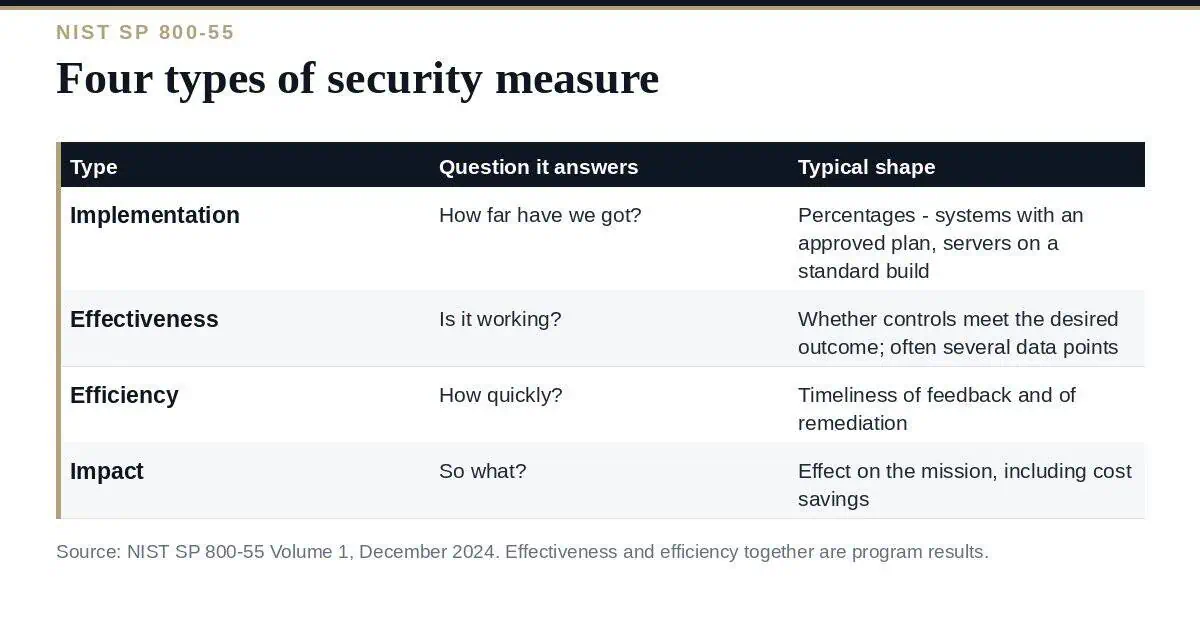
SP 800-55 separates measures and assessment results into four types. Knowing which one you are holding stops most reporting arguments before they start.
| Type | Question it answers | Typical shape |
|---|---|---|
| Implementation | How far have we got? | Percentages — systems with an approved security plan, servers on a standard configuration |
| Effectiveness | Is it working? | Whether controls meet the desired outcome; may need several data points |
| Efficiency | How quickly? | Timeliness — how fast a control gives useful feedback and how fast issues are addressed |
| Impact | So what? | Effect on the mission — including cost savings produced by the security program |
NIST groups effectiveness and efficiency together as “program results”, and makes one point that is easy to miss: implementation measures are never fully retired, because they are the record of what exists and what still needs improvement. What changes as a program matures is that reporting broadens beyond them.
Most dashboards of cybersecurity metrics are 90% implementation measures, which is why they feel busy and say little. Patch coverage tells a board how much of the work is done. It does not tell them whether patching is fast enough to matter, which is an efficiency measure, or what it has prevented, which is an impact one.
SP 800-55 recommends documenting each measure in a standard format so that development, collection and reporting are repeatable — a consistent record of what is measured, where the data comes from, what formula is used and who touches the data. The fields it offers as a starting point are the closest thing to a cybersecurity metrics template that exists in public guidance:
Two of those fields carry most of the weight. Target is what turns a number into a judgment: without it, every review meeting re-litigates whether 94% is good. Implementation evidence is what turns a number into an argument you can defend to an auditor, because it names what you would show to prove the activity happened.
NIST describes measure development as four activities: identify and define the current security program; develop, test and validate specific measures; prioritize them against organizational needs; and evaluate the data you collect.
The identification stage is where most programs skip a step. It calls for an accounting of assets and their potential impact, the stakeholders and what they actually want from measurement, documented security goals that can be translated from technical data into business intelligence, a review of existing policies and procedures, and a review of the measures and data repositories you already have. That last one matters commercially: the cheapest measure is one whose data you are already collecting for another reason.
Prioritization is the discipline. A measure that nobody acts on has a cost — collection, validation, review time — and no return. If the answer to “what would we do differently if this number moved?” is nothing, it is not a metric, it is a statistic.
Three cybersecurity metrics with owners, formulas, targets and evidence will change more behavior than thirty without them.
Choose the collection frequency from the rate of change you are trying to observe, and the reporting frequency from external requirements and what your internal audience actually wants — those are two different decisions, and conflating them is why teams end up collecting monthly data for an annual report.
For a board pack, lead with efficiency and impact, keep implementation as supporting detail, and never present a number without its target next to it. Key performance indicators and key risk indicators are the reporting layer above this: the measure is the instrument, the indicator is the reading you have agreed to watch. Our guide to cybersecurity KRIs and KPIs covers that division.
What is the current NIST guidance on cybersecurity metrics?
SP 800-55 in two volumes, both published December 2024. Volume 1 covers identifying and selecting measures; Volume 2 covers developing a measurement program. They replace SP 800-55 Revision 1 from 2008.
What is the difference between a metric and a measure?
In NIST’s usage, measures are the documented, formula-driven quantities; metrics is the looser everyday word for the same thing. What matters is not the label but whether the number has a scope, a formula, a target and named owners.
How many metrics should we report?
Fewer than you are collecting. Prioritize against organizational needs, and drop any measure that would not change a decision.
Can we use qualitative measures?
Yes. SP 800-55 Volume 1 covers both quantitative and qualitative assessment, and effectiveness can legitimately be applied as a yes/no judgment where the evidence supports it.
How do these relate to ISO 27001?
Clause 9.1 of ISO 27001 requires you to determine what needs monitoring and measuring, the methods, and when results are evaluated. The SP 800-55 format is a practical way to answer that clause without inventing your own.
Good cybersecurity metrics are not a longer dashboard. They are a small set of measures, each with a stated goal, a scope, a formula, a target, evidence and an owner — mostly implementation early on, shifting toward efficiency and impact as the program matures. Write the documentation once for each measure, decide the collection and reporting frequencies separately, and be ruthless about dropping numbers that nobody acts on.
Ready-built indicator sets, definitions and reporting templates are in the Critical IT and Cybersecurity Indicators pack, or start with the free ISO templates.

October 23, 2026
October 23, 2026
October 22, 2026
October 22, 2026
October 22, 2026

