CART
A FedRAMP ATO is a decision a single federal agency makes about a single use of a cloud service — and under the Consolidated Rules for 2026 it is deliberately no longer the same thing as being “FedRAMP authorized”. FedRAMP now certifies the service and packages the evidence; the agency still decides whether to accept the risk and issue the authorization to operate.
Confusing the two is the most expensive misunderstanding in federal cloud sales, because it is what leads a provider to tell an agency that no further work is required. This guide sets out how a FedRAMP ATO is granted in 2026, the five steps an agency actually runs, and the dates that decide which path you are on.
Free gap assessment
Are you working to the 2026 FedRAMP rules or the old ones?
Score the Key Security Indicators and the CR26 obligations, free, including the Security Decision Record that replaced the SSP.
Run the free FedRAMP gap assessment → or View premium report sample
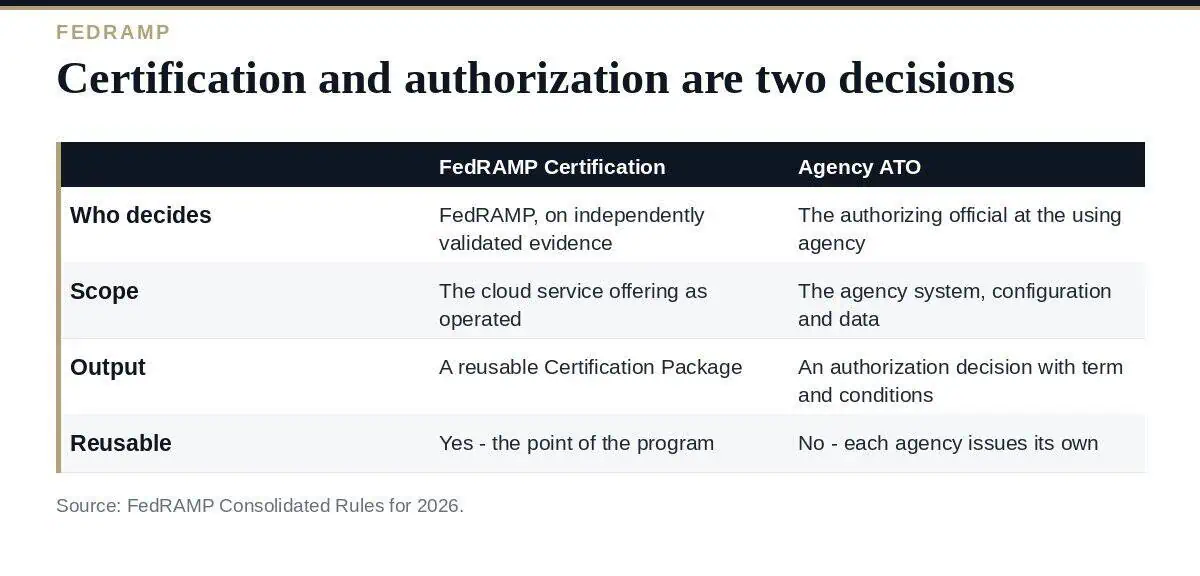
FedRAMP Certification is the status of a cloud service offering that has been assessed under FedRAMP practices. It produces a Certification Package that agencies may treat as presumptively adequate evidence for the provider’s part of the system. It does not authorize anything by itself.
The authorization to operate is the agency’s risk decision about its own system: the configuration it chose, the data it will put in the service, the integrations it built, and the controls it inherits versus the ones it implements. Two agencies using the same certified service will hold two different authorizations, because they made two different decisions.
| FedRAMP Certification | Agency ATO | |
|---|---|---|
| Who decides | FedRAMP, on evidence validated by an independent assessor | The authorizing official at the using agency |
| Scope | The cloud service offering as the provider operates it | The agency’s system, configuration and data |
| Output | A reusable Certification Package | An authorization decision with a term and conditions |
| Reusable? | Yes — that is the point of the program | No — each agency issues its own |
The Consolidated Rules describe initial agency authorization as a sequence the agency owns from beginning to end.
The agency describes the work the service will support, who will use it, and what federal information it will handle — including features, data flows, integrations and prohibited uses. It categorizes the system under FIPS 199 and FIPS 200 and selects the control baseline from NIST SP 800-53B. Everything downstream depends on this being written down honestly; a categorization set low to make the paperwork easier is the failure that surfaces at the worst possible time.
The agency reviews the available Certification Packages against that need: the security capabilities of each offering, the configurations the agency itself would have to apply, and the assessment results. This is where a provider’s package earns its keep or fails to.
Using the provider’s Secure Configuration Guide, the agency checks that the service actually supports the intended implementation — identity integration, logging, administrative controls, data protection options. A limited pilot is encouraged where it reduces uncertainty, but a pilot does not waive any authorization requirement.
The agency configures the service, implements the controls that are its own responsibility, tests the implementation, and documents it in the agency System Security Plan. The rules are explicit that the agency does not copy the provider’s package into its own plan — inherited controls are referenced, not restated.
The agency completes its authorization documentation, makes the decision, notifies FedRAMP and supplies the required information, and moves into ongoing authorization. Continuous monitoring is a condition of the authorization staying valid, not an afterthought.
One constraint is worth planning around: agencies are told not to authorize a FedRAMP Class A service for longer than twelve months unless the provider is pursuing a higher certification class. Class is a tiered measure of assurance, and a Class A offering supplies the least of it — so a low-class certification buys market access but leaves every customer on a short renewal cycle.
The Consolidated Rules for 2026 took effect on 4 July 2026 as the point at which all stakeholders should begin adopting or transitioning to them. The dates that follow are the ones to plan against:
The practical reading for a provider: 20x is now the forward path and does not require an agency sponsor, while Rev5 remains available to those already in it but is closing to newcomers in mid-2027. The practical reading for an agency: a Certification Package you are handed in 2027 may have been built under either ruleset, and the class tells you how much assurance sits behind it.
Treating certification as the finish line. It is the start of the sales conversation, not the end. The agency still has to categorize, configure, test and document.
Writing a configuration guide for engineers, not authorizing officials. Step three of the agency process runs on the Secure Configuration Guide. If it does not clearly say how identity, logging and data protection are configured for federal use, the agency has to discover it by trial, and that time comes out of your sales cycle.
Assuming equivalency. FedRAMP does not support or provide “equivalency”, and it is not the route to defense contractor requirements — CMMC questions go to the Department of Defense, not to FedRAMP.
Is a FedRAMP ATO the same as FedRAMP authorization?
Not under the 2026 rules. FedRAMP Certification is the program’s status for a cloud service offering; the ATO is the individual agency’s decision to operate its own system using that service.
Does 20x still need an agency sponsor?
No. The 20x path was designed to be available to any provider that can demonstrate government-wide use, which is what removed the sponsor bottleneck.
How long does a FedRAMP ATO last?
It is set by the authorizing official and maintained through continuous monitoring. For a Class A service, agencies are directed not to authorize for more than twelve months unless the provider is pursuing a higher class.
Do agencies still write a System Security Plan?
Yes — the agency’s own plan, covering its configuration and the controls it implements. What changed is the provider’s base system security plan, which has been replaced.
Can we reuse another agency’s ATO?
You reuse the Certification Package, not the authorization. Each agency issues its own.
The 2026 rules made explicit what was always true: FedRAMP validates evidence, agencies accept risk. If you are a provider, the fastest FedRAMP ATO is the one where your package answers the agency’s step-one questions before they are asked, and where your configuration guide survives contact with an authorizing official. If you are an agency, the five steps are yours — categorize honestly, compare packages against the actual use, pilot where uncertainty is real, and keep your own plan rather than importing the provider’s.
The templates and registers behind a certification package are in the FedRAMP Toolkit, rebuilt for the Consolidated Rules for 2026, or start with the free ISO templates.

October 22, 2026
October 22, 2026
October 22, 2026
October 22, 2026
October 22, 2026

