CART
In February 2024, ISO added two sentences about climate change to roughly 31 management system standards at once. The ISO climate change amendment is the smallest change most auditors have ever had to check, and it is still the one that catches organisations out, because a passing mention of climate in a context document is not what it asks for.
This guide covers exactly what was added, what an auditor looks for as evidence, and the naming trap that leads people to cite a document that has since been withdrawn.
Free gap assessment
Are you ready for the 2026 edition of ISO 14001?
Score every clause of the new edition, free, including the aspects, life cycle and compliance evaluation work that carries most of the findings.
Run the free ISO 14001 gap assessment → or View premium report sample
ISO and the IAF published a joint communiqué on 22 February 2024, and the text went into the standards the following day. There are only two additions, and they sit in clause 4, the context of the organization.
| Clause | What it now says, and what it means |
|---|---|
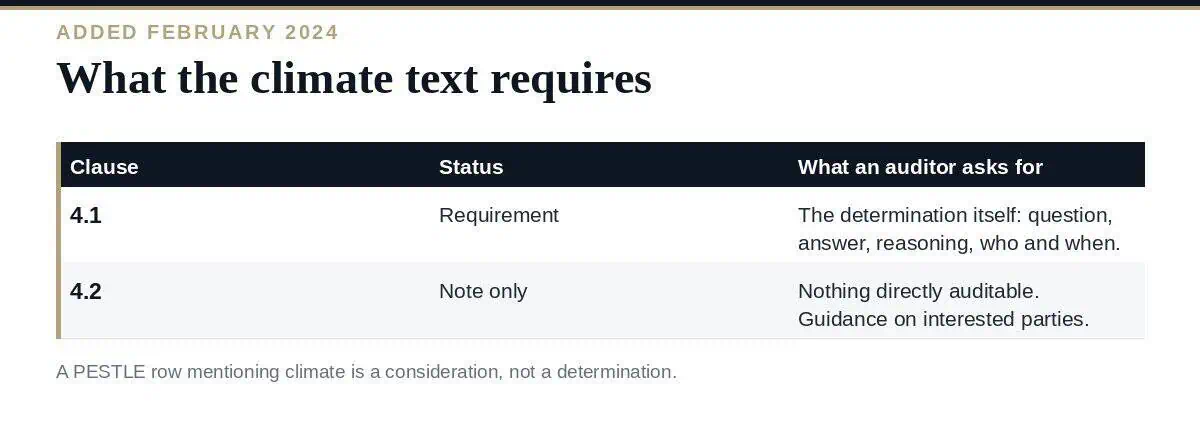
| 4.1 | You shall determine whether climate change is a relevant issue. This is a requirement, it uses the word shall, and it produces something an auditor can ask to see. |
| 4.2 | A note that relevant interested parties can have requirements related to climate change. A note is guidance, not a requirement, so nothing is directly auditable here. |
That is the entire ISO climate change amendment. It applies to the standards built on the harmonized structure, which is why it landed across quality, environment, information security, health and safety and business continuity simultaneously. If you want the wider picture of why one edit reaches 31 standards, see what Annex SL is.
This is the trap. The climate text was originally issued as an amendment to each standard, with designations like ISO 9001:2015/Amd 1:2024. Those amendment documents are withdrawn once the parent standard is revised, because the next edition absorbs the text.
So a policy or manual that cites Amd 1:2024 is pointing at a superseded document, which is exactly the sort of stale reference an auditor raises a finding on. Write against the current edition’s clauses 4.1 and 4.2 instead, and cite the standard rather than the amendment.
One consequence that surprises people: the parent standard’s foreword may not itemise the climate change at all. The text arrives through the identical core text that the standard already declares conformance to, so its absence from a list of changes does not mean it is missing.
This is where most organisations lose a finding they did not need to lose. The requirement is a determination, and a determination has a shape.
A PESTLE row that mentions climate is not a determination. Neither is an environmental policy that talks about carbon, nor a risk register with a weather-related entry. Those are considerations. What clause 4.1 asks is whether climate change is a relevant issue for this management system’s ability to achieve its intended results, and that question needs an answer.
A determination that satisfies an auditor generally has four parts: the question asked in the standard’s own terms, the answer, the reasoning behind it, and who made the call and when. It lives naturally in whatever document already records your clause 4.1 analysis, which for most systems is a context and interested parties record.
Answering no is completely legitimate. The standard does not require climate change to be relevant to you. It requires you to have determined the question. A software company with no physical estate can reasonably conclude that climate change is not a relevant issue for its information security management system, provided that conclusion is reasoned and recorded rather than assumed.
A determination that climate change is relevant, sitting alone in a context document, is decorative. Clause 4.1 feeds clause 6.1, so a relevant issue should appear as a risk or opportunity with planned action, and it should surface again as a management review input.
An auditor following the thread from 4.1 to 6.1 to 9.3 and finding it stops at the first step will treat that as a broken chain rather than as compliance. If you are working through this, our guides to clause 4 and clause 6 cover both ends of it.
The ISO climate change amendment does not ask you to reduce emissions, set a net zero target, produce a carbon footprint or publish a climate report. It does not trigger recertification, and it is not a transition in the sense that a new edition of a standard is. Certification bodies fold it into the next scheduled surveillance visit.
It also does not turn a quality or information security system into an environmental one. The question is narrow: does climate change affect this system’s ability to do what it is meant to do.
The joint communiqué is published by the International Organization for Standardization. Context and interested parties templates are included in the Integrated Management System Toolkit and the individual standard toolkits, or start with the free ISO templates.
Verified against the ISO/IAF joint communiqué of 22 February 2024 and current standard editions. Position as at 6 September 2026.

October 22, 2026
October 22, 2026
October 22, 2026
October 22, 2026
October 22, 2026

