CART
Authorised Economic Operator status is what a customs authority gives a business it has decided to trust. It is the closest thing international trade has to a security certification with real operational value — fewer physical inspections, priority treatment, and recognition at partner borders — and it is assessed against four tests that most applicants underestimate.
This guide covers the two authorisation types, the four criteria, what an audit actually examines, and how AEO sits against ISO 28000.
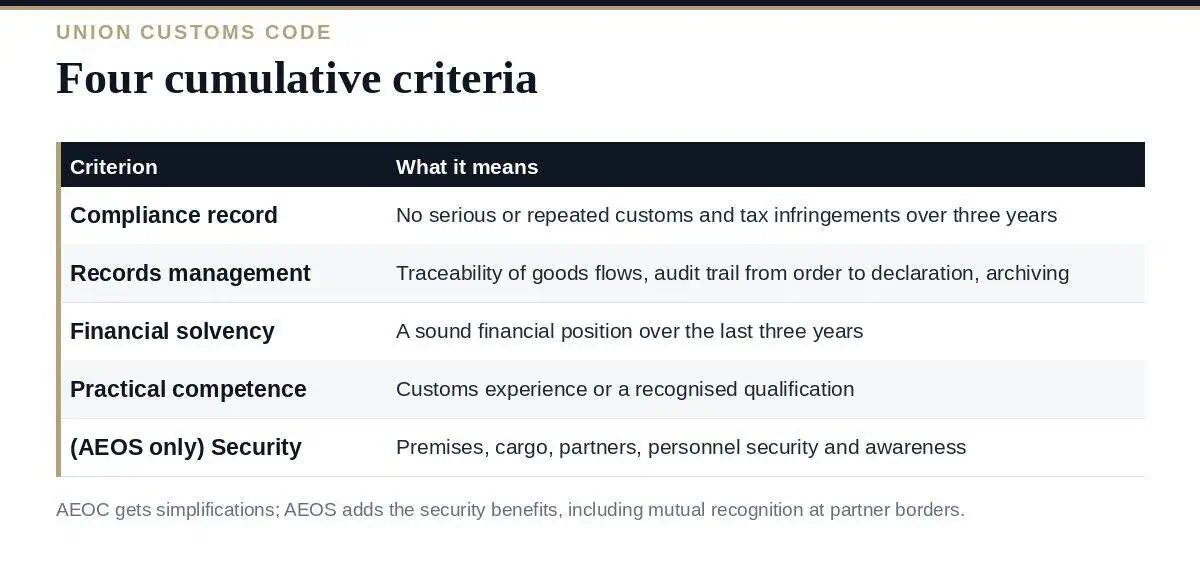
Under the Union Customs Code, status is granted as an authorisation rather than a certificate, and there are two:
They can be held together, and many traders do. The distinction matters commercially: the security-and-safety criterion is not assessed for AEOC, so an AEOC holder does not get the security-related benefits — including the mutual recognition that speeds goods through third-country borders.
| Benefit | What it means in practice |
|---|---|
| Lower risk score | Fewer documentary and physical controls selected by the risk system |
| Priority treatment | If a control is selected, it is carried out first, and can be moved elsewhere |
| Simplifications | Easier access to procedures such as self-assessment and centralised clearance |
| Mutual recognition | Equivalent treatment under arrangements with partner programmes |
| Commercial signal | Recognition as a secure and compliant partner, increasingly a tender requirement |
For AEOS a fifth applies: appropriate security and safety standards across premises, cargo, business partners, personnel security and security awareness. That is the criterion where a management system pays for itself.
An Authorised Economic Operator audit is a visit. They test the records claim by tracing real consignments end to end, they look at physical security — fencing, access control, CCTV, sealing, loading areas — and they read your procedures for handling incoming goods, checking business partners and vetting staff in sensitive roles. The self-assessment questionnaire you complete first is the map they audit against, which is why an honest one produces a shorter visit than an optimistic one.
Authorised Economic Operator status and ISO 28000 are not the same thing, and they support each other well. ISO 28000 is a management system standard for security in the supply chain — certifiable, international, and organized around risk assessment, controls and continual improvement. AEO is a customs authorisation granted by an authority against its own criteria, with legal facilitations attached.
An operating ISO 28000 system covers a large part of the AEOS security criterion: security risk assessment, premises and cargo controls, personnel security, partner requirements and incident handling all map across. It does not cover the customs-specific criteria — compliance record, records management, solvency and customs competence — which are where AEOC applicants spend their time. Our guide to ISO 28000:2022 covers the standard, and the two supply chain assurance routes covers where each one applies.
Records that cannot be traced end to end. The single most common failure. If a customs officer cannot follow a consignment from purchase order to declaration to payment in your systems, the criterion is not met.
Business partners unassessed. Security is a chain property. An applicant with excellent premises and no requirements imposed on hauliers or warehouse providers has secured one link.
Customs knowledge in one person’s head. The competence criterion is about the organization, and a single unbacked specialist is a risk the authority will name.
Treating it as a one-off. Status is monitored and can be suspended or revoked. Changes to premises, ownership, systems or the person responsible for customs have to be notified, and re-assessment follows material change.
What is an Authorised Economic Operator?
A trader authorised by its customs authority as reliable and secure, granted either customs simplifications (AEOC), security and safety facilitations (AEOS), or both.
How long does authorisation take?
Months rather than weeks. The authority has defined periods to accept and decide the application, and the preparation — records, procedures, physical security — is usually the longer part.
Is it recognised outside the EU?
Through mutual recognition arrangements with partner programmes, including the US C-TPAT and several Asian schemes. The benefits available depend on the specific arrangement.
Do we need ISO 28000 as well?
No. It is not a prerequisite, and it is a substantial head start on the AEOS security criterion — as well as covering suppliers and sites that fall outside the customs authorisation.
Can status be withdrawn?
Yes. It is monitored continuously, and serious infringements, loss of solvency or unnotified material change can lead to suspension or revocation.
Decide first whether you need AEOC, AEOS or both, because the security criterion is the expensive one and it only applies to AEOS. Then prove the records criterion to yourself before applying: pick three real consignments and trace them end to end through your own systems. Extend security requirements to the partners who handle your goods, spread customs competence beyond one person, and treat the authorisation as a standing obligation — Authorised Economic Operator status is monitored, and the notification duty does not lapse once the certificate arrives.
Security risk assessments, partner requirements and procedure templates are in the ISO 28000 Supply Chain Security Toolkit, or start with the free ISO templates.

October 23, 2026
October 23, 2026

October 22, 2026
October 22, 2026
October 22, 2026

