CART
The Cyber Essentials questionnaire is the whole of the basic certification: you answer it, a board-level signatory declares it accurate, and an assessor marks it. From April 2026 the questions come from a new set called Danzell, and it is stricter than the one it replaced — several answers now fail the assessment outright.
This guide covers what the questionnaire asks, what changed with Danzell, the auto-fail answers, and how to prepare so the submission is a formality rather than a discovery exercise.
Free gap assessment
Have you cleared Implementation Group 1?
Score all 18 Controls, free, with IG1 treated as the floor rather than the starting point, so you find out whether the basics are actually covered.
Run the free CIS Controls gap assessment → or View premium report sample
Cyber Essentials is a self-assessment scheme. There is no site visit and no evidence upload at the basic level: the assessor marks your written answers against the scheme’s requirements, and a board member, owner or equivalent signs a declaration that the answers are true. That declaration is the reason the questionnaire is worth taking seriously — it is a statement by the organization, not a form filled in by IT.
The Cyber Essentials questionnaire is grouped into a scope section followed by the five technical controls: firewalls, secure configuration, security update management, user access control, and malware protection. Our guide to Cyber Essentials certification covers what each control requires.
The Cyber Essentials questionnaire asks what is in scope before it asks anything technical, and every later answer is read against that boundary. Whole-organization scope is the default expectation; a narrower scope is permitted but has to be described, and what sits outside it has to be described too. Devices in scope include the laptops, desktops, tablets, phones, servers, firewalls, routers and cloud services used to access organizational data or services — including devices owned by staff and used for work.
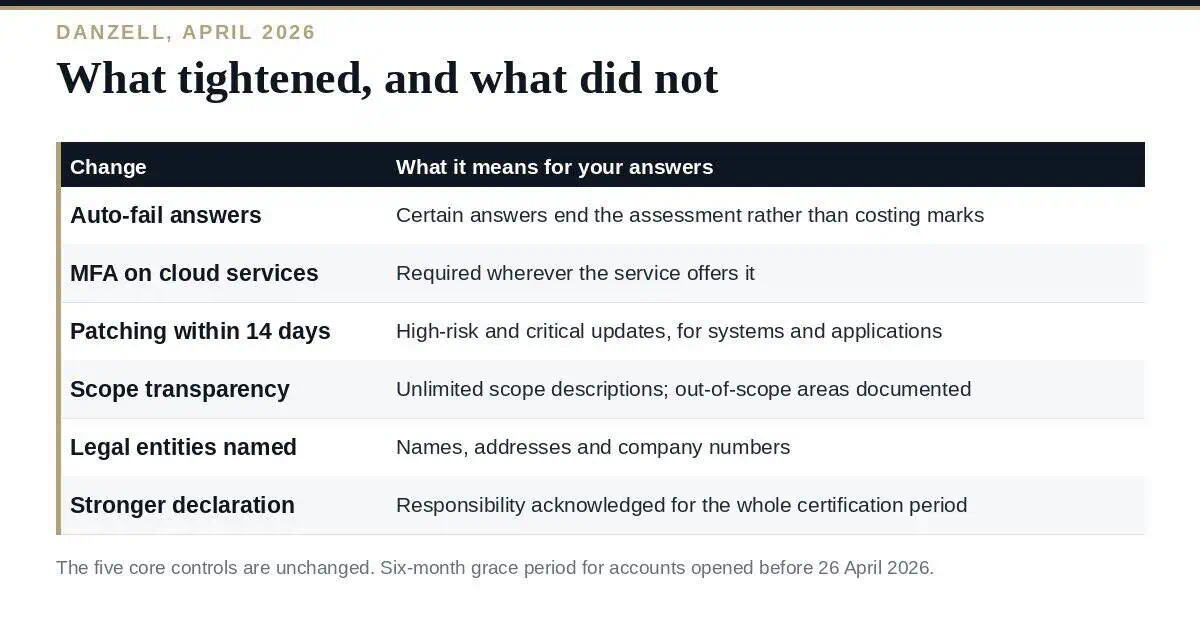
IASME’s update states the new Cyber Essentials questionnaire came into force on 26 April 2026, with a six-month grace period for organizations whose assessment accounts already existed. The five core controls are unchanged. What changed is the strictness:
| Change | What it means for your answers |
|---|---|
| Auto-fail answers | Certain answers end the assessment rather than costing marks |
| MFA on cloud services | Required wherever the service offers it — no longer a partial answer |
| Patching within 14 days | High-risk and critical updates for operating systems, routers and firewall firmware, and for applications |
| Scope transparency | Unlimited-length scope descriptions, and out-of-scope areas must be documented |
| Legal entities named | Names, addresses and company numbers, with individual certificates available per entity |
| Stronger declaration | The signatory now acknowledges responsibility for maintaining the controls throughout the certification period |
That last row is a quiet but real change. Certification was already a point-in-time statement; the declaration now says plainly that the controls are expected to hold for the year, not just on submission day.
Three answers in the Cyber Essentials questionnaire are worth checking twice. Staff-owned devices used for work email are in scope, and their patch status is usually unknown. Cloud services bought by a department outside IT are in scope, and often have MFA available but not enforced. Home routers are generally out of scope where the device’s own software firewall is enabled and configured — but the answer has to reflect the actual configuration, not the assumption.
How many questions are in the Cyber Essentials questionnaire?
It varies with the question set and how many entities and technologies you declare. Expect the scope section plus the five control areas, with follow-up questions triggered by what you have in scope.
Do we submit evidence with the answers?
Not at the basic level — the assessment marks your written answers. Cyber Essentials Plus is where technical verification happens, and we cover the Plus audit separately.
What happens if we fail?
You are told which answers failed. Certification bodies typically allow a resubmission within a short window; beyond that a new application is required.
Who has to sign the declaration?
A board member, owner or equivalent senior person. It cannot be delegated to the IT team that prepared the answers.
How long is certification valid?
Twelve months, and the Danzell declaration makes the expectation of ongoing compliance during that period explicit.
Treat the Cyber Essentials questionnaire as an audit you administer to yourself. Build the asset list, verify patch dates and MFA coverage before answering rather than afterwards, describe the scope in full now that length is no longer capped, and check your answers against the auto-fail conditions — a single unsupported operating system or an unpatched critical update inside scope ends the assessment regardless of how strong everything else is.
Asset registers, policy templates and an answer-preparation checklist are in the Cyber Essentials UK Toolkit, or start with the free ISO templates.

October 23, 2026
October 22, 2026
October 22, 2026
October 22, 2026
October 22, 2026

