CART
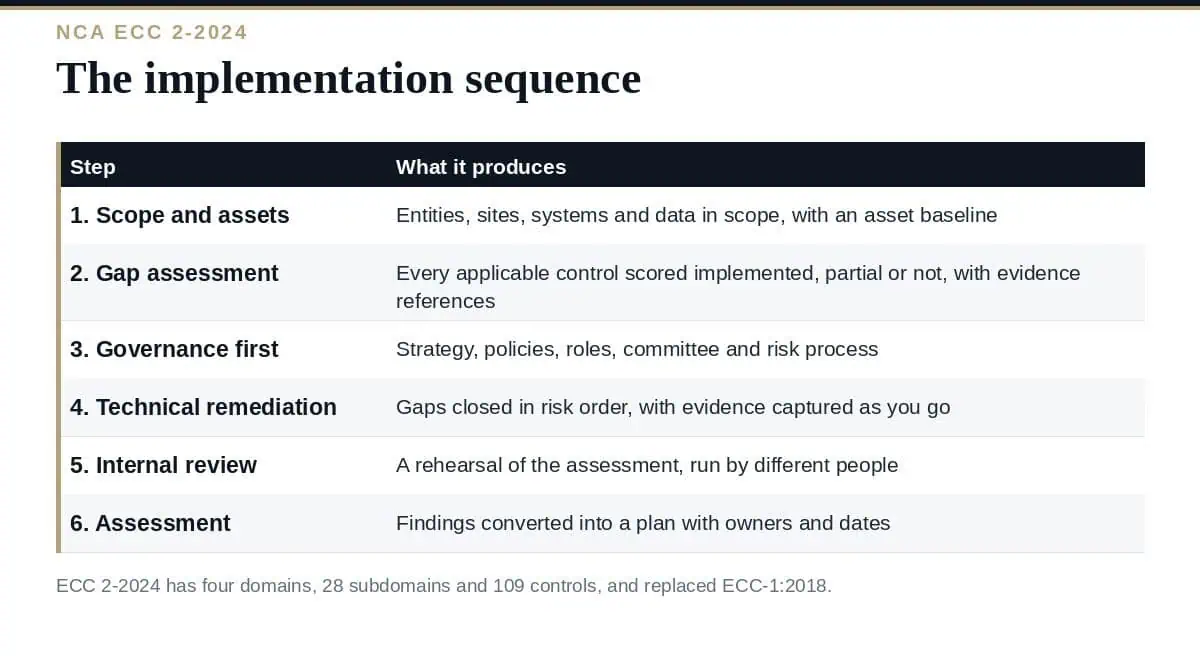
NCA ECC implementation is a compliance exercise, not a certification project, and that distinction changes how you should run it. Saudi Arabia’s National Cybersecurity Authority assesses organizations against the Essential Cybersecurity Controls — currently ECC 2-2024, with four domains, 28 subdomains and 109 controls — rather than issuing a certificate through an accredited body.
This guide sets out the implementation sequence, what evidence each control needs, and the two mistakes that make an otherwise complete programme fail an assessment.
Free gap assessment
How much of ECC-2:2024 is actually in place?
Score all 28 subdomains, free, plus the other NCA control sets that apply alongside the ECC.
Run the free NCA ECC gap assessment → or View premium report sample
Two checks come before any NCA ECC implementation work, and both are cheap to do and expensive to skip.
Which entity type are you? The ECC reaches government agencies, their affiliated companies and entities inside and outside the Kingdom, and private-sector entities that own, operate or host Critical National Infrastructure. If you are a financial institution you may also sit under the SAMA Cyber Security Framework — a different authority with a maturity-based assessment. Our guide to SAMA CSF versus NCA ECC covers the overlap.
Which control sets apply? The ECC is the baseline, but the NCA publishes a family. If you use or provide cloud services the Cloud Cybersecurity Controls apply; if you run operational technology the OTCC does; critical systems and data have their own sets. Establishing this at the start prevents the most expensive failure mode — building a programme against the ECC alone and discovering a second control set during assessment. See our guide to the seven NCA control sets.
And cite the edition. ECC 2-2024 replaced ECC-1:2018 and reduced the framework from five main domains to four; documentation still quoting the 2018 numbering is quoting controls that in some cases no longer sit in the ECC at all.
Each control needs three things, and most programmes produce only the first two:
The record is the one that decides an assessment. A policy requiring quarterly access reviews plus an identity platform capable of them is not implementation; four quarters of completed reviews with names against them is.
Building against the ECC alone. The other control sets apply by what you operate, not by who you are, and they are written as extensions rather than alternatives. An organization with cloud services and OT systems is in scope for three sets at once and its documentation has to cite them accurately.
Treating the ECC as a document-writing exercise. The controls are phrased around defined, implemented and periodically reviewed practice. A complete policy library with no operating records reads as a programme designed for the assessment rather than for the organization — and assessors have seen a great many of those.
NCA ECC implementation is faster if you hold ISO 27001: you already have the management system, most of the governance layer and a large share of the technical controls. That is a genuine head start, and mapping your Statement of Applicability to the ECC is usually the fastest first pass at the gap assessment.
What it does not do is satisfy the ECC. The NCA has its own control text, its own numbering and Kingdom-specific expectations that no international standard reaches. Map ISO 27001 in as evidence; do not offer the certificate as an answer.
Is NCA ECC compliance a certification?
No. Organizations are assessed for compliance against the controls rather than certified by an accredited body the way ISO 27001 works.
Which ECC edition applies?
ECC 2-2024, which replaced ECC-1:2018 and moved from five main domains to four. Documentation citing the older edition should be rewritten rather than renumbered.
Do we need the other NCA control sets?
It depends on what you operate — cloud services, operational technology, critical systems and certain data types each bring their own set, written as extensions of the ECC.
How long does implementation take?
For an organization with an existing ISMS, months rather than a year, with the evidence history being the constraint. Starting from nothing, plan for a full cycle of reviews and audits before you can evidence “periodically reviewed”.
Who owns it internally?
A named cybersecurity function reporting at a level that can enforce governance. The ECC expects defined roles and authority, and an assessment will look for them.
Start NCA ECC implementation with scope, edition and the question of which control sets apply — those three answers determine the size of the work. Build the governance layer before the technical fixes, keep the operating record as you implement rather than reconstructing it later, and rehearse the assessment internally. And cite ECC 2-2024 explicitly everywhere, because a document quoting a superseded edition looks exactly like a correct one until somebody checks.
Policies, control mappings and assessment evidence templates are in the NCA Cybersecurity Toolkit, or start with the free ISO templates.

October 22, 2026
October 22, 2026
October 22, 2026
October 22, 2026
October 22, 2026

