CART
The CIS Benchmarks and the CIS Controls come from the same organization, are often named in the same sentence, and answer completely different questions. The Controls tell you what to do and in what order. The Benchmarks tell you how to configure a specific piece of technology once you have decided to do it.
Confusing them produces two recognizable failures: a security program that adopts a framework and never changes a single system setting, or a hardening project that locks down servers while the asset inventory nobody maintains hides half the estate. This guide sets out what each is, how they fit together, and which one to reach for.
Free gap assessment
Have you cleared Implementation Group 1?
Score all 18 Controls, free, with IG1 treated as the floor rather than the starting point, so you find out whether the basics are actually covered.
Run the free CIS Controls gap assessment → or View premium report sample
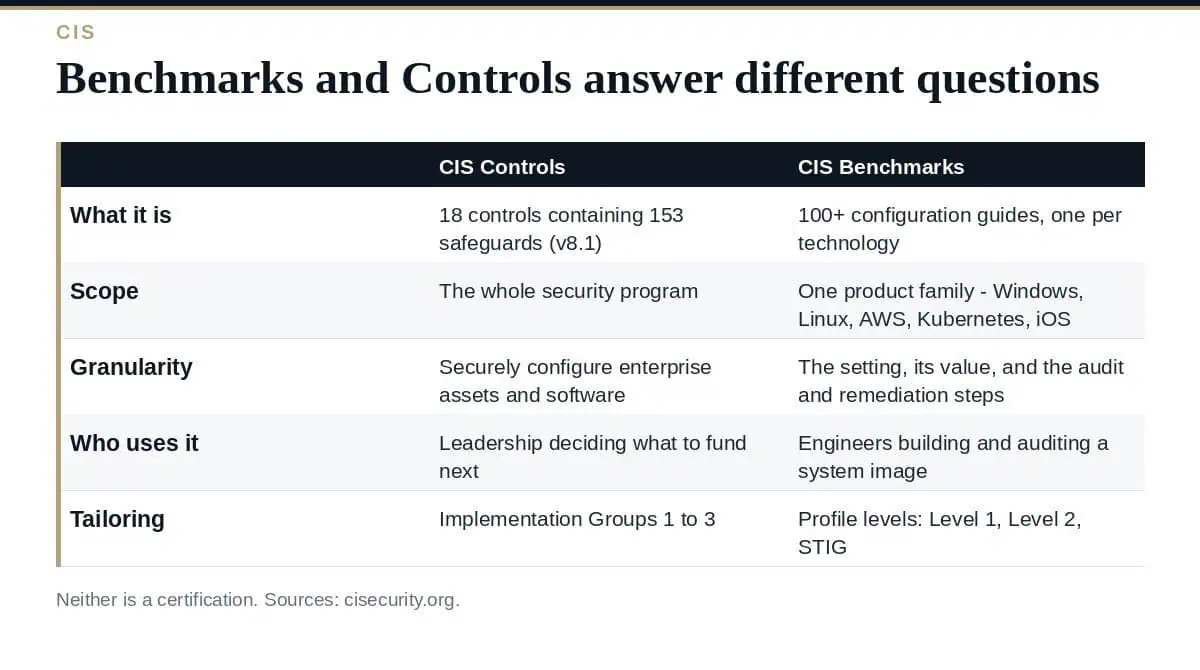
| CIS Controls | CIS Benchmarks | |
|---|---|---|
| What it is | A prioritized set of 18 controls containing 153 safeguards (v8.1) | 100+ prescriptive configuration guides, one per technology |
| Scope | The whole security program | One product family at a time — Windows, Linux, AWS, Kubernetes, Cisco, iOS |
| Granularity | “Securely configure enterprise assets and software” | The specific setting, its recommended value, and the audit and remediation steps |
| Who uses it | Security leadership planning what to fund next | Engineers building and auditing a system image |
| Tailoring | Implementation Groups 1 to 3 | Profile levels — Level 1, Level 2, and a STIG profile |
Each benchmark is a consensus-developed configuration guide for one technology, covering more than 25 vendor product families across operating systems, cloud providers, server software, network devices, mobile platforms, desktop applications and DevSecOps tooling. Every recommendation states the setting, the rationale, how to audit it and how to remediate it — which is what makes a benchmark usable as an engineering document rather than a policy.
They are published free of charge in PDF form. Membership products layer tooling on top: automated assessment against a benchmark, tailored recommendation sets, and pre-hardened virtual machine images for cloud deployment.
Choose the profile per system class, not per organization. A domain controller and a developer laptop do not belong on the same profile, and pretending otherwise is how a hardening project stalls at the first outage.
The join is precise. The Controls include a safeguard requiring secure configuration of enterprise assets and software and the maintenance of documented configuration standards. The Benchmarks are those configuration standards, already written, already justified, already auditable. Adopting the relevant benchmark discharges the “documented standard” half of the safeguard on day one and leaves you the harder half — deployment, drift detection and exception management.
Read in that direction, the pairing is efficient:
When a customer questionnaire or a contract says “CIS”, it almost always means one of two things, and the distinction changes the work:
Neither is a certification. There is no CIS certificate and no accredited body auditing you against either document — which is exactly why the evidence you keep yourself matters. Where a certifiable framework is the goal, both feed it: ISO 27001 needs configuration standards and evidence of their application, and CIS material supplies both without inventing house rules from scratch. See our guide to the Statement of Applicability for where that evidence lands.
Are the CIS Benchmarks free?
Yes, as PDF downloads. Automated assessment tooling, tailored benchmarks and pre-hardened cloud images sit behind membership.
How many CIS Benchmarks are there?
More than 100 configuration guides spanning over 25 vendor product families, from operating systems and cloud platforms to network devices, browsers and container tooling.
Should we apply Level 1 or Level 2?
Level 1 as the default; Level 2 for systems where security outweighs convenience and where you can test the impact first. The STIG profile only if DISA STIG compliance is a requirement.
Can we be certified against the CIS Benchmarks?
No. You can produce an assessment report showing conformance to a named benchmark and profile, and that is what customers actually ask for.
Do the CIS Benchmarks replace the CIS Controls?
No — they implement part of them. The Controls set priorities across the whole program; the Benchmarks answer one safeguard, deeply, per technology.
Use the CIS Controls to choose the work and the CIS Benchmarks to do it. Pick the Implementation Group that matches your size and risk, adopt the benchmark for each platform you run, set the profile level per system class rather than across the estate, and keep an exception register with owners and review dates. The pairing costs nothing to obtain and removes the two most common excuses in a security program — not knowing what to do next, and not knowing what “hardened” means.
Configuration standards, exception registers and safeguard implementation records are in the CIS Controls v8.1 Toolkit, or start with the free ISO templates.

October 25, 2026
October 24, 2026
October 24, 2026
October 23, 2026
October 23, 2026

