CART

ISO 22301 templates divide into two groups that behave very differently: a small
management-system layer that looks like any other ISO standard, and a much larger operational layer
that has no equivalent anywhere else in the ISO catalogue.
ISO 22301:2019 is the second edition, published October 2019, and it uses the harmonized structure
— clauses 4 to 10, shared with ISO 9001, ISO 27001 and the rest. So the governance half is familiar:
context, leadership, planning, support, performance evaluation and improvement.
The operational half is where a business continuity document set earns its keep, and it is
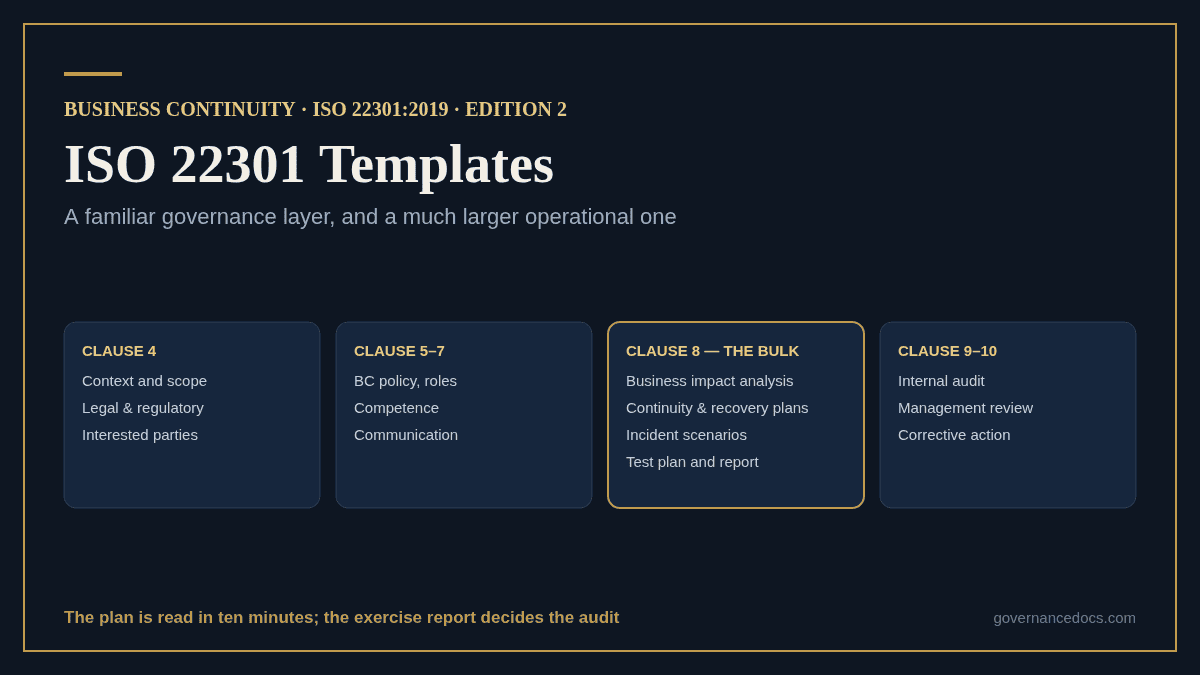
disproportionately large. In a working pack, clause 8 alone accounts for more documents than clauses
4, 5, 6 and 7 combined.
| Clause | Documents the set has to deliver |
|---|---|
| 4 — Context | Context and scope, legal and regulatory requirements procedure and list, interested parties register |
| 5–7 — Governance | BC policy, roles and responsibilities, competence and awareness, communication, document control |
| 8 — Operation | BIA procedure and report, risk assessment and treatment, continuity strategies, continuity and recovery plans, incident scenarios, test plan and report, supplier evaluation, post-incident report |
| 9–10 — Evaluation | Monitoring and measurement, internal audit programme and checklists, management review, nonconformity and corrective action |
The BIA is the document the rest of the system hangs from, and it is the one most often done badly.
It establishes which activities matter, how quickly each must resume, and what it depends on — and
those answers drive your strategies, your plans, your test scenarios and ultimately your costs.
Two failures recur. The first is asking business owners how quickly they need their process back
without any constraint, which reliably produces a list where everything is critical within an hour.
The second is a BIA that records recovery objectives but not dependencies, so the plans built on it
assume systems, people and suppliers that will not be available.
A worked example is worth more than a blank form here. Our guide to the
business impact analysis
covers the method; what a template set should add is a completed illustration you can argue with.
Four families have no counterpart in a quality or security pack.
Continuity and recovery plans. Distinct things: the continuity plan keeps
prioritised activities running at an agreed reduced level; the recovery and restoration procedure
returns to normal. Sets that merge them tend to describe the first and quietly omit the second.
Disruptive incident scenarios. The situations you plan against — loss of premises,
loss of IT, loss of key staff, supplier failure. These drive the tests.
Test plans and reports. Clause 8 requires exercising, and the report is what proves
it happened and what it found.
Post-incident reports. After a real disruption, the record of what happened and
what changed as a result.
The operational half, not just the policy half.
The ISO 22301 Toolkit ships 78 editable documents in clause order, with the operational layer carrying the weight: BIA procedure, report and a worked illustrative example, risk assessment and treatment, disruptive incident scenarios, recovery and restoration, business continuity test plan and report, supplier BC evaluation and post-incident reporting — plus the internal audit checklists and management review pack for clauses 9 and 10.
An auditor can read a continuity plan in ten minutes and learn very little. What they examine is
whether it has been exercised, what the exercise found, and what changed afterwards.
That makes the test plan and test report the highest-value documents in the set, and it argues for
exercising early and imperfectly rather than late and tidily. A first test that fails and produces
three corrective actions is stronger evidence of a working system than a polished plan nobody has
tried. Keep the scope small enough to actually run — one scenario, one site, a fixed time box.
ISO lists ISO 22301:2019 at stage 90.92, “to be revised”. No successor has been published, so the
2019 edition remains the standard you are audited against, and documentation written to it is current.
It is worth knowing for planning rather than for panic. The harmonized structure is stable across
revisions, so clause-ordered documents survive an edition change with their numbering intact — which
is a good reason to keep alignment statements in one consistent form rather than scattered through
every document in eight different wordings.
ISO 22301 templates cannot run your BIA workshops, agree recovery objectives with business owners, or negotiate
the budget that turns a strategy into an actual capability. A template can hold the answer to “how
long can we be without this?” — it cannot produce it.
They also cannot exercise your plans, and that is the gap certification most often turns on: a
complete document set describing a capability nobody has tested.
ISO 22301 is certified against a defined scope, and the scope decides how much of the operational
layer you actually build. A BCMS covering one service line at two sites is a different proposition
from one covering a whole group.
The temptation is to scope broadly because it sounds more impressive on a certificate. The cost
lands in clause 8: every additional activity brings its own BIA entries, dependencies, continuity
strategy and exercise obligations. A narrow first scope that is genuinely exercised certifies more
easily and extends later; a broad one tends to produce plans that exist on paper for activities nobody
has time to test.
State the scope precisely — legal entities, sites, services and the interfaces to anything outside
it — because interfaces with excluded parts of the business are where auditors probe.
ISO 22301 templates are more heavily tailored than most sets, because continuity is inherently
specific. Recovery time objectives, dependency maps and incident scenarios cannot be inherited from a
generic pack in any meaningful way.
What good ISO 22301 templates give you is the structure and the arguments: the fields a BIA needs so the answers
are comparable across departments, scenarios broad enough to adapt, and a test report format that
records what failed rather than only what passed. Expect to spend most of your effort on the BIA and
the plans, and comparatively little on the clauses 4 to 10 layer, which is close to portable between
management systems.
How many documents does ISO 22301 require?
The standard mandates certain documented information and implies more through its record
requirements. See ISO 22301
mandatory documents for the required list, clause by clause.
Is a business continuity plan the same as a BCMS?
No. The plan is one document; the management system is the governance, analysis, testing and
improvement around it. Certification assesses the system.
Can I reuse ISO 27001 templates?
The clauses 4 to 10 layer transfers well, because both use the harmonized structure. The clause 8
operational layer does not — a BIA, continuity strategies and exercise reports have no ISO 27001
equivalent.
Is ISO 22301:2019 still current?
Yes. ISO marks it “to be revised” but no successor has been published, so it remains the edition in
force.
How often must plans be exercised?
The standard requires exercising at planned intervals rather than naming a frequency. Annual is the
common interpretation, with additional tests after significant change.
A BCMS decays faster than most management systems, because the things it describes keep moving —
staff leave, suppliers change, systems migrate, sites close. A continuity plan naming a person who
left eighteen months ago is worse than no plan, because it will be followed.
Two maintenance habits carry most of the weight. Review contact and dependency details on a fixed
cycle regardless of whether anything is known to have changed, since the whole problem is that changes
are not reported. And treat every exercise and every real incident as an input to the plans rather
than an event to be recorded and filed — the post-incident report exists to change something.
Judge ISO 22301 templates on the operational half. The clauses 4 to 10 governance layer is close to
interchangeable with any other harmonized-structure pack; the BIA, the continuity and recovery plans,
the scenarios and the exercise records are what make the set specific to business continuity.
Then get something exercised early. The document set is the cheap part, and the test report is the
evidence that decides your audit.
The full set is available as the ISO 22301 Toolkit, or start with the free ISO templates.

August 31, 2026
August 31, 2026
August 31, 2026
August 31, 2026
August 31, 2026